
Uncategorized
Used TTI Pit Viper Gun for Sale – The Complete Buyer’s Guide to the John Wick 4 Pistol
What Is the TTI Pit Viper and Why Is Everyone Looking for One?
The Taran Tactical Innovations Pit Viper is not a standard production pistol. It is a hand-fitted, fully compensated 2011-style competition handgun built by Taran Butler — one of the most decorated action shooting competitors in the world — and it became a household name in the firearms community after serving as John Wick’s primary sidearm in the final act of John Wick: Chapter 4.
That alone would generate interest. But the Pit Viper earned its reputation before the cameras ever rolled. The firearm was developed by Taran Butler in direct collaboration with Keanu Reeves and the film’s production team. Reeves, known for his dedication to training, spent countless hours at the TTI facility mastering the Pit Viper’s handling. The gun seen on screen is not a non-functional prop — it is the real deal.
What that means for buyers today is straightforward: you are not purchasing hype. The Pit Viper is a genuine competition-grade firearm that happened to become one of the most recognizable pistols ever filmed. The combination of real-world performance and cultural cachet has driven persistent demand on both the primary and secondary markets.
New models routinely sell at or above $7,499.99 retail, carry wait times measured in months, and are frequently unavailable altogether. That is precisely why so many buyers are searching for a used TTI Pit Viper for sale — and why listings move quickly when they appear.
At Tactical Firearms Gear and Viper Guns, we source and list pre-owned Pit Vipers and the broader Viper family with full condition disclosures. If you want to know what is currently available, the fastest route is through our live chat — our team is online and can check current inventory in real time.
What Makes the Pit Viper Different From Every Other 2011 on the Market
The 2011 platform — a double-stack evolution of the classic 1911 — has produced dozens of outstanding pistols. The Pit Viper occupies a very specific position within that field, and understanding why matters before you spend $3,500 to $6,400 on a used example.
The Sight Block Compensator — the Feature That Defines the Gun
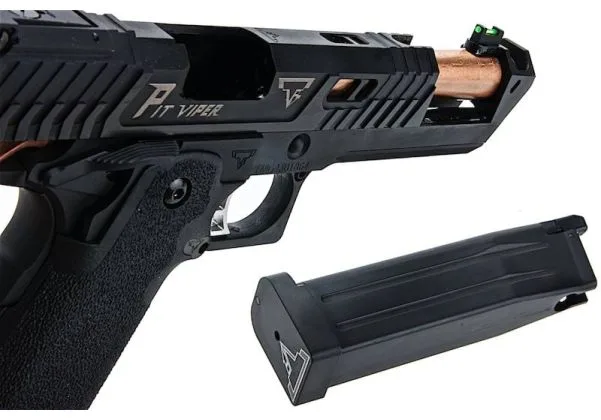
The most dramatic feature of the Pit Viper is the sight-block compensator attached to the barrel. Compensators redirect gases to reduce recoil and muzzle rise, allowing faster shots with more accuracy. The Pit Viper’s compensator works extremely well. Critically, the front sight is attached to the compensator rather than the slide, meaning it does not reciprocate during recoil. Slide-mounted sights move with every shot. The Pit Viper’s front sight stays fixed to the barrel, making it far easier to track during rapid fire.
This is not a cosmetic distinction. In competition shooting, tracking your sights between shots is one of the primary limiting factors on split times. A stationary front sight is a genuine mechanical advantage.
The Trigger
The Pit Viper features a race-gun trigger with a pull weight of approximately 1.75 to 2.25 pounds. After 800 rounds, the platform delivers on its promise of speed and accuracy. For context, most service pistols break between 5 and 7 pounds. The Pit Viper trigger is not modified for feel — it is engineered for competitive split times.
Between the trigger attributes and the compensator, the Pit Viper is one of the fastest and flattest shooting pistols on earth.
The Shooting Experience
On the range, the combination of the compensator, sight block, and superb ergonomics makes recoil feel more like a gentle push than a sharp snap. The dot on the fiber optic front sight barely moves from the target, allowing shots to be placed with surgical precision at a blinding pace.
The Pit Viper shoots so flat it feels like shooting a .22 LR pistol with high-velocity ammunition. This is clearly the combination of the sight block, compensator, slide weight, and spring balance. [Guns.com]
What the Pit Viper Is Not Built For
The race-gun trigger and ammo sensitivity from the compensator make the Pit Viper impractical for defensive carry use. This is a competition and range platform. Buyers who need a daily carry 2011 should look at the Staccato P or similar. The Pit Viper is for people who want the best possible performance on a square range or in a competition setting, and who understand what they are buying. [USA Gun Shop]
Used TTI Pit Viper Pricing: What to Expect in 2025–2026
The average used Taran Tactical Pit Viper is worth $3,500 to $6,400. A new Taran Tactical Pit Viper costs at least $7,499.99 at retail. The value is affected by condition.
Several variables push a specific listing higher or lower within that range.
Condition Grading Guide
Like New / Unfired — Original finish, no handling marks, factory accessories present. Expect pricing near the top of the used range. Some buyers treat these as collectibles and will pay a premium to avoid an example that has been shot at all.
Excellent — Light handling marks only, fully functional, minimal visible wear. The most common condition for a Pit Viper that has seen range use but was well cared for. Represents the sweet spot for buyers who want to shoot the gun without paying collector-condition prices.
Very Good — Moderate use, minor cosmetic blemishes, strong mechanical condition. Still a capable competition platform; the cosmetics do not affect performance. Often represents good value for competition shooters who are indifferent to finish wear.
Good — Noticeable wear, fully operational. Suitable for regular range use. Lower collector value; higher practical value for buyers who want to run the gun hard.
Fair — Significant cosmetic wear, potential replacement parts needed. Lower end of the value range. Requires careful inspection before purchase.
What Accessories Add to Value
Original box and documentation, factory-included magazines, and any accompanying optic (the newer Pit Viper models include an optic cut) all affect the final price. A used Pit Viper sold with the Trijicon SRO or similar mounted optic, original packaging, and multiple magazines commands meaningfully more than the same gun sold stripped.
Pit Viper vs Sand Viper — Understanding the Difference Before You Buy
This is one of the most common questions buyers bring to us, and the answer is more interesting than most people expect.
According to TTI, the Pit Viper was the original design. It was made for the John Wick 4 movie and set to launch around the movie premiere back in 2021. However, the premiere kept getting pushed back — first because of COVID, and then because of the release of The Matrix Resurrections. The studio did not want two major Keanu Reeves films released in the same season. This left TTI with an inventory problem. The guns did not yet have their final coating applied, so the decision was made to change the color, add an optic cut, and rebrand the design as the Sand Viper.
In other words, the Sand Viper exists because the John Wick 4 premiere was delayed. The guns share the same core architecture.
The primary difference: the Pit Viper features an integrated sight block, meaning the front sight is fixed to the barrel and does not move with the slide. It uses a single-port compensator. The Sand Viper lacks the sight block — its front sight is mounted to the slide in a traditional manner. It features a two-port compensator built into the slide.
For competition use, the Pit Viper’s stationary front sight is a genuine advantage for shooters who prefer iron sights. The Sand Viper’s optic cut makes it better suited to red dot mounting. Neither is objectively superior — the right choice depends on how you intend to run the gun. If you are unsure which configuration suits your shooting style, reach out via live chat on Tactical Firearms Gear and we can walk through the difference with you directly.
How the Pit Viper Compares to Other Premium 2011s
The TTI Pit Viper sits at the top of the 2011 food chain alongside guns like the Atlas Athena. For pure competition use, it is hard to beat. The Staccato XC at roughly half the price offers around 85% of the performance, and the Canik TTI Combat at one-eighth the price is the smarter buy for 90% of shooters. The Pit Viper is for the remaining 10% who accept no compromises and have the budget to match.
Community discussions among serious 2011 shooters draw a similar conclusion. The gun shoots very nicely — it is surprisingly flat, and the compensator works better than many. It is reasonably soft, which is notable given how light it is. Overall, it gives the characteristics most 2011 buyers are looking for: a flat, soft, and fast gun.
Where the Pit Viper draws criticism is not in performance but in build-quality-relative-to-price. Some experienced 2011 shooters describe the TTI 2011s as having added branding, serrations, and coloring over a production base, with a premium attached to the name. That is a fair assessment of the value calculus for a pure performance buyer. For a buyer who also values the John Wick association, the cultural significance, and the exclusivity, the premium is part of what they are paying for — and there is nothing wrong with that.
What to Inspect Before Buying a Used TTI Pit Viper
Purchasing a pre-owned firearm at this price point requires methodical evaluation. Do not skip any of these checks.
Verify Authenticity
Confirm serial numbers, original manufacturer markings, and Taran Tactical Innovations branding. Request purchase documentation where available. Aftermarket components and counterfeit builds do exist in the premium 2011 market. A legitimate Pit Viper should have consistent TTI markings and verifiable provenance.
Examine the Compensator and Sight Block
The compensator is the defining mechanical feature of the Pit Viper. Inspect for excessive carbon fouling at the ports, any cracking or deformation, and proper alignment with the barrel. The sight block should be firmly attached with no movement. Any play in the sight block is a red flag.
Check Slide-to-Frame Fit
A quality Pit Viper should have a tight, consistent slide-to-frame fit. Excessive play or unusual wear patterns suggest either high round count abuse or a potential fitting issue. On the bench, the slide should cycle smoothly with no grinding or rough spots.
Function Check Every Control
Verify the trigger (reset should be short and positive), magazine release, slide stop, and ambidextrous thumb safeties. Dry-fire the gun with permission to feel the trigger break. Any creep or mushiness that does not match the expected 1.75–2.25 pound pull warrants investigation.
Ask About Round Count and Maintenance History
A Pit Viper that has seen 10,000 rounds of competition use is different from one that has been shot a few hundred times. Spring replacement intervals, barrel condition, and any previous gunsmithing work are all relevant to the purchase decision.
Does a Used TTI Pit Viper Hold Its Value?
The short answer is yes, more consistently than almost any other premium handgun.
Several factors sustain demand on the secondary market. Production numbers are limited. Retail wait times remain long. The John Wick franchise continues to drive cultural interest. And the underlying performance of the platform gives it genuine utility as a competition tool, not just a collector’s piece.
If you are selling a Pit Viper, expect it to sit well above typical handgun prices. It is a specialist, performance piece rather than an everyday carry gun.
For buyers, this means a well-maintained used Pit Viper purchased today is unlikely to lose significant value over a reasonable ownership period, particularly if you retain the original box, documentation, and accessories.
Where to Buy a Used TTI Pit Viper
Tactical Firearms Gear and Viper Guns are your best starting point. They specialize in the Viper family of TTI pistols and maintain regular inventory of both the Pit Viper and Sand Viper on the used market. Every listing includes full condition disclosure, photographs, and pricing based on current market data.
Our team is available via live chat on both sites. If you are actively looking for a specific configuration — a particular finish, optic-ready setup, or one with original accessories — drop us a message in chat and we will notify you as soon as a matching example comes in. Live chat is the fastest way to get a real answer on availability without waiting for an email response.
Beyond our own inventory, reputable sources for used Pit Vipers include licensed FFL dealers handling consignment premium firearms, and established online firearm auction platforms where collector-grade examples occasionally surface. Always verify transfer requirements in your jurisdiction before purchasing.
Frequently Asked Questions
What caliber is the TTI Pit Viper chambered in?
The standard production Pit Viper is chambered in 9mm Luger. This is the configuration featured in John Wick: Chapter 4 and the version most widely available on both the primary and secondary markets. The 9mm chambering also makes it compatible with the high-capacity 20-round double-stack magazines the platform is designed around.
Why does the TTI Pit Viper cost so much?
The price reflects significant research and development required to perfect the unique sight block and compensator design, the fact that it is a race-ready competition gun right out of the box, and the brand recognition that both TTI and the John Wick franchise carry. Add hand-fitting, premium DLC coatings, and limited production volume, and the price becomes easier to understand even if it remains a significant commitment.
Is the Pit Viper the same gun used in John Wick 4?
Yes. The firearm developed for the film was built in direct collaboration with Keanu Reeves and the production team. The JW4 Pit Viper seen on screen is not a prop — it is the real firearm. The production model sold to civilians is functionally identical to what appears in the film.
What is the difference between the Pit Viper and the Sand Viper?
The Pit Viper features an integrated sight block with the front sight fixed to the barrel, and uses a single-port compensator. The Sand Viper lacks the sight block, mounts the front sight to the slide in traditional fashion, and features a two-port compensator built into the slide. The Sand Viper also has a different finish color and an optic cut. For buyers who prefer iron sights and the fixed front sight advantage, the Pit Viper is the choice. For red dot users, the Sand Viper’s optic cut is the more practical setup.
Can the TTI Pit Viper be used for concealed carry or home defense?
The race-gun trigger pull weight and ammo sensitivity from the compensator make the Pit Viper impractical for defensive use. It is engineered exclusively for competition and range performance. The trigger weight that makes it exceptional in a match environment creates safety and reliability concerns in a defensive context. For a premium 2011 suitable for carry, the Staccato P or C2 are the appropriate alternatives.
How long is the wait for a new TTI Pit Viper from TTI directly?
Wait times have historically ranged from several months to over a year depending on production capacity and demand cycles. This is one of the primary reasons buyers turn to the used market — immediate availability at a price that, while still significant, is below new retail.
Is the TTI Pit Viper worth the price compared to a Staccato XC?
The Staccato XC at roughly half the price offers about 85% of the Pit Viper’s performance. The Pit Viper is for the 10% of shooters who accept no compromises and have the budget to match. Community consensus among experienced 2011 shooters is that the Staccato XC is the rational performance choice, while the Pit Viper makes sense for buyers who also value the TTI brand, the John Wick association, and the specific mechanical advantages of the sight block compensator system.
Does a used TTI Pit Viper come with a warranty?
New Pit Vipers include a TTI manufacturer warranty. Used examples sold privately or through third-party dealers typically do not carry the original warranty. When purchasing through Tactical Firearms Gear or Viper Guns, ask our team via live chat about any applicable coverage on specific listings.
What magazines does the TTI Pit Viper use?
The Pit Viper uses a proprietary double-stack 2011 magazine system. Factory magazines are typically 20-round capacity. Aftermarket options exist from manufacturers including MBX and Grams, but factory TTI magazines are preferable for reliability and value retention.
Is the TTI Pit Viper a good investment?
As a collector piece, its track record on the secondary market is strong. It sits well above typical handgun prices and is a specialist, performance piece with limited supply and sustained demand. That said, no firearm should be purchased purely as a financial instrument. The Pit Viper holds value well, but the better reason to own one is because it is an extraordinary shooting platform with genuine historical significance in the premium handgun world.
Final Word
The TTI Pit Viper is not for everyone. It is expensive, it requires a specific type of owner, and there are competing 2011 platforms that offer comparable performance at lower cost. But for the buyer who wants the best compensated 2011 on the market, the one that won the USPSA 2-Gun Nationals and starred in one of the most technically accurate firearms sequences in action film history, there is no substitute.
If you are ready to find yours, browse current inventory at Tactical Firearms Gear and Viper Guns, or open the live chat now. Our team is available and can match you with the right used Pit Viper based on your budget, intended use, and preferred configuration.
